


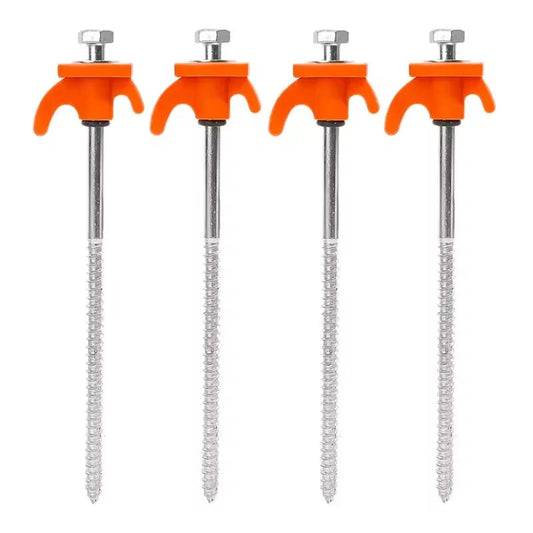
Anchor — Screw-In Tent Stakes
Regular price
$29.00

Roughly the lower two-thirds of each shaft is cut as a coarse spiral thread, ending in a sharp tip. A smooth pin holds by friction down its sides, which is why hard, dry or stony ground keeps pushing one back out as the line pulls on it. A thread has to be unwound, so the ground around the whole helix is working against the pull rather than a thin strip of it. We do not publish a holding-force number: that figure belongs to the soil you are standing on, not to the stake.

The top of each stake is a hex bolt head sitting on a steel washer. Hit it with a hammer or a mallet and it goes in like a nail. Or put a socket on the head — by hand, or on a cordless drill — and thread it in instead, which is the quieter way and the easier one when the ground fights back. A hammer, mallet, drill and socket are not included; use the ones you already carry.

Under the head is a molded plastic collar with two arms. Guy lines, tarp loops and canopy straps drop into the curve and stay seated while the line is under tension. The same arms give your fingers something to pull against when you take the stake out — turn it counterclockwise rather than hauling straight up, because the thread that held it down is still holding. A rubber O-ring below the collar keeps it from sliding loose on the shaft.

A stake holds best when it leans away from what it is holding. Put it in at about 60 degrees to the ground, with the head tilted away from the tent, and sink it until roughly 1.5 in is left above the surface. Run the guy line to the hook, down by the ground, not up near the head. A stake stood upright, or left half out, is the one that works loose in the night.

The collar is bright orange. In long grass, at dusk, or when you are striking camp in a hurry, that is the part you see — which makes it harder to walk into a guy line and harder to drive away with a stake still in the ground. The steel underneath is bright plated.

Count the points you actually tie down, then add a spare. A small dome tent is usually six — four corners and a couple of guy lines. A rectangular tarp is four corners plus whatever guys run off the ridge. A canopy is one at each leg, and one more on every guy once the wind gets up. The packs come as 4, 8 or 10 stakes, so you can cover a whole pitch in one go or top up the set you already carry.

| Material | Carbon steel shaft, molded plastic collar |
|---|---|
| Finish | Bright plated steel |
| Length | About 20 cm / 7.9 in — manufacturer stated |
| Head | Hex bolt head on a steel washer — takes a hammer, a socket wrench or a drill |
| Shaft | Smooth upper section, coarse spiral thread over roughly the lower two-thirds |
| Tip | Pointed |
| Collar | Two-arm plastic hook for guy lines, with a rubber O-ring below it |
| Color | Orange |
| Pack sizes | 4, 8 or 10 stakes |
| Setting | About 60 degrees to the ground, with about 1.5 in left above the surface — manufacturer guidance |
| Suited to | Hard, dry, compacted, rocky or gravelly ground; grass and packed dirt |
| Not suited to | Loose dry sand and deep soft mud — a thread needs something to bite into |
| In the pack | Stakes. The manufacturer also shows a storage bag; no hammer, mallet, drill or socket |
Why a threaded stake instead of a straight one?
In hard or stony ground a straight pin holds only by the friction along its sides, and a steady pull on a guy line works it back up. A thread has to be turned out before it will lift, so more of the surrounding ground resists the pull. In soft, loose ground the difference is smaller — there a wide straight peg is often the better tool.
How long are they?
The manufacturer lists each stake at about 20 cm, which is 7.9 in. We have not measured them ourselves, so treat that as the stated figure rather than a tested one.
How should I set them?
At about 60 degrees to the ground, leaning away from the tent, with roughly 1.5 in left above the surface. Tie the line at the hook, low down, rather than near the top of the head.
Do I need a hammer?
In most ground, yes — strike the hex head to start it and drive it home. You can also fit a socket over the hex head and turn it in, by hand or with a cordless drill, which takes less swinging in ground that resists. No hammer, mallet, drill or socket comes in the pack.
How do I get them back out?
Turn them counterclockwise. The plastic hook gives you something to grip, and a socket on the hex head makes it quicker. Pulling straight up works against the thread, which is the one thing the stake is built to resist.
Will they hold in sand or soft mud?
Not well. A thread needs ground firm enough to hold its shape around it, so loose dry sand and deep mud are the wrong conditions for these. They are at their best in hard, dry, compacted or rocky ground.
Do they come with a bag?
The manufacturer shows a small storage bag with the stakes. We have not checked every pack size ourselves, so count on the stakes and treat the bag as a likely extra.
Do they come in other colors?
No. We sell them with the orange collar only, because it is the one that is easiest to see on the ground.
How many should I buy?
Count the tie-down points on what you are pitching, then add two spares. A small tent is usually six, a rectangular tarp four corners plus the guys, a canopy four legs plus guys at each corner.
When will it arrive, and what if it is not right?
Orders are prepared in 1–3 business days and delivered in 7–15 business days from the ship date. You have 30 days from delivery to return them; tell us within 7 days if anything arrives damaged or if the wrong item was sent. Manufacturing defects are covered for 90 days. We reply within one business day, Monday to Friday.
Shipping
Orders are prepared within 1–3 business days. Shipping to the United States typically takes 7–15 business days after dispatch. Tracking is provided once your order ships.
Returns
30-day return window. Unused items can be returned within 30 days of delivery in their original packaging, with all included accessories — email us first to start a return. If an item arrives damaged or incorrect, send a photo to support@thehalovera.com within 7 days of delivery and we will replace it or refund you in full. Every product carries a 90-day warranty against manufacturing defects. Read the Refund Policy.
Don't forget! The products that you viewed. Add it to cart now.
Here’s some of our most similar products people are buying. Click to discover trending style.